
(215) 855-5489 | Worship Summer Sundays @ 9:30 a.m.
(215) 855-5489 | Worship Summer Sundays @ 9:30 a.m.
Read the latest news for our church.
Apr 15, 2026
As we approach St. John’s 150th anniversary in 2026, we are digging deep into the church archives to connect with the stories that shaped us. John Hendricks, our Photographer and Archivist, has worked faithfully for 15 years to maintain and share important pieces of our history. Leaning on his extensive knowledge and storytelling ability, we are excited to share these artifacts and anecdotes as a way to honor the past and imagine what the next 150 years could bring.
by John Hendricks, St. John’s Archivist
St. John’s has held many fundraising events over 150 years. In recent years we have had basket raffles, hoagie and cookie sales, spud lunches and more. Farther back we had the rummage sales, sauerkraut and baked beans suppers, apple festivals and more. But perhaps the most adventurous took place when St. John’s was just 3 years old in 1879, a one-day trip adventure of about 300 miles to Rockaway Beach, NY.!
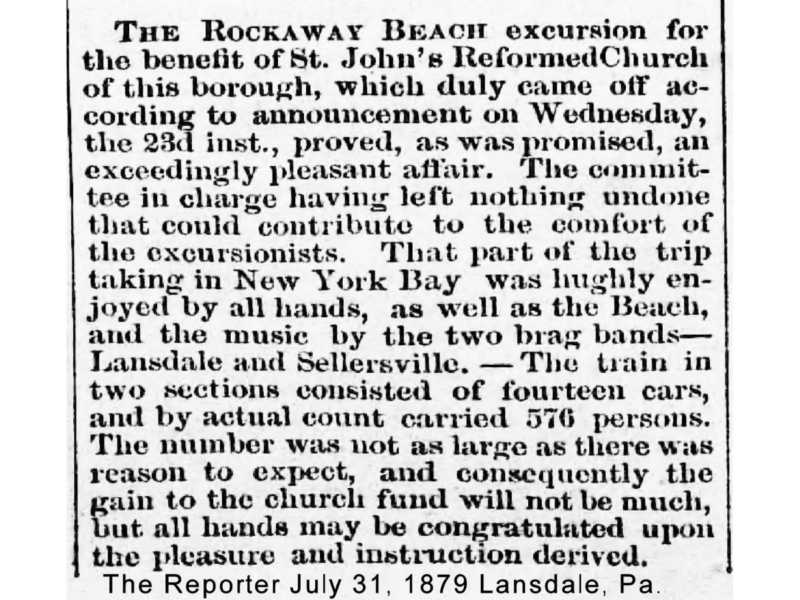
The Reporter of July 3, 1879, announced the trip. “A grand excursion under the auspices of St. John’s Reformed Church, Lansdale, and for its benefit, is now being arranged, and to take place Wednesday, July 23, 1879. (After taking the train from Lansdale to Bethlehem) the excursion will start at Bethlehem via. North Penn. & Bound Brook railroads to Jersey City (arriving 10 am); thence by splendid steamer (the Grand Republic) to the famous seaside at Rockaway Beach for 5 hours…tickets only $2.50”.
The Brooklyn NY Daily Times of July 24, 1879, colorfully reported the Lansdale visitors. “The Sellersville and Lansdale Coronet Bands…brought to the beach nearly 800 people. On arriving at the dock, the passengers were formed in line, with the Lansdale band in front, and then marched over to the surf. After reaching the ocean front, the 2 bands played alternate pieces, and were loudly applauded by the crowd. The bands and their friends took possession of the 2nd floor of the Mammoth Pavillion, where they gave a concert to several thousand spectators. The crowd then separated and made a dash for the ocean. As most of them came especially for the bath, the water on either side of Remsen Av. was black with human beings, bobbing up and down in a most hilarious manner. The surf was quite heavy and just suited the country lads and lassies, and they tumbled in the angry waves like so many ducks. The excursionists, after their dip in the ocean, had luncheon, then whiled the time away in dancing and strolling on the strand until the Grand Republic returned on her homeward trip.”
The Reporter on July 31 said the trip was an “exceedingly pleasant affair”. “The train in 2 sections consisted of 14 cars…carrying 576 persons. The number was not as large as there was reason to expect, and consequently the gain to the church fund will not be much, but all hands may be congratulated upon the pleasure and instruction derived.” There is no record of St. John’s trying another fundraiser this ambitious again, but it’s fun to picture our “country lads and lassies” of 1879 taking such a journey in one day!
Mar 15, 2026
As we approach St. John’s 150th anniversary in 2026, we are digging deep into the church archives to connect with the stories that shaped us. John Hendricks, our Photographer and Archivist, has worked faithfully for 15 years to maintain and share important pieces of our history. Leaning on his extensive knowledge and storytelling ability, we are excited to share these artifacts and anecdotes as a way to honor the past and imagine what the next 150 years could bring.
by John Hendricks, St. John’s Archivist
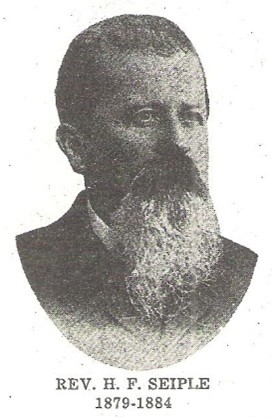
Last month we wrote about the life of St. John’s first pastor, Rev. Henry Franklin Seiple, voted unanimously as our first permanent pastor by the St. John’s members on June 30, 1879, and serving as a ‘shared’ pastor for 5 years with the Reformed churches in Hilltown and Dublin. This month we will look at his pastorate here and after that time.
By his first anniversary in 1880, The Reporter wrote “during the year 27 persons were baptized, 41 added to the communicant membership of the church…the charge is in a prosperous condition, and by the blessing of the Great Head of the Church, a bright future is ahead.” On October 26, 1882, the Perkasie News Herald noted “Rev. H.F. Seiple of Lansdale, Hilltown and Dublin congregations has been with them for 3-1/2 years, in which time he has preached and lectured 650 times, confirmed and received by certificate 138 persons, solemnized 33 marriages, officiated at 71 funerals, and baptized 100.” His journeys to Hilltown, Dublin and parishioners were made by horse & wagon from his farm on West Main Street, Lansdale, where he lived the rest of his life.
In June of 1884, Rev. Seiple was injured in a fall from a third-story window in his home. He was granted a 3-month leave by the Hilltown charge, and Rev. Maxwell Rowland was appointed to fill in for him. He resigned as St. John’s pastor that August. Some versions of our history state that he resigned due to “ill health”. While he had health issues, it is more likely he resigned because at the time St. John’s became detached from the Hilltown charge to become ‘independent’, supported by the Tri-Synodic Board of Home Missions. However, Rev. Seiple continued as the pastor in Hilltown and in Dublin for another 13 years, still performing many weddings and funerals in Lansdale. In 1897, ill health finally forced his resignation from Dublin and Hilltown. He was afflicted with diabetes for 12 years and blind his final year, no longer able to serve as a pastor, and passed away peacefully at home on October 22, 1908, at age 65.
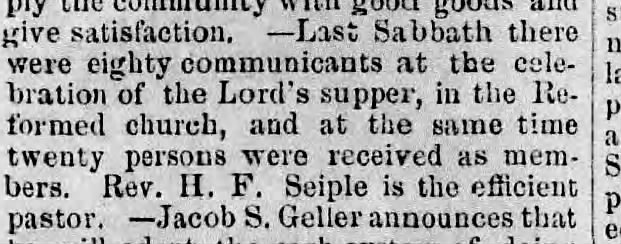
Although a ‘shared’ pastor with 3 churches, stories from the time tell of his popularity. In 1882, St. John’s members showed up at his home with gold coins, a study lamp, and other tokens of friendship. One evening in 1884, 60 members from Hilltown surprised him at his home with a picnic dinner, cash gifts and groceries, and after speeches, the party continued late into the night. Even in a short 5 years as pastor of St. John’s, Rev. H.F. Seiple became a beloved member of the Lansdale community for almost 30 years!
Feb 15, 2026
As we approach St. John’s 150th anniversary in 2026, we are digging deep into the church archives to connect with the stories that shaped us. John Hendricks, our Photographer and Archivist, has worked faithfully for 15 years to maintain and share important pieces of our history. Leaning on his extensive knowledge and storytelling ability, we are excited to share these artifacts and anecdotes as a way to honor the past and imagine what the next 150 years could bring.
by John Hendricks, St. John’s Archivist
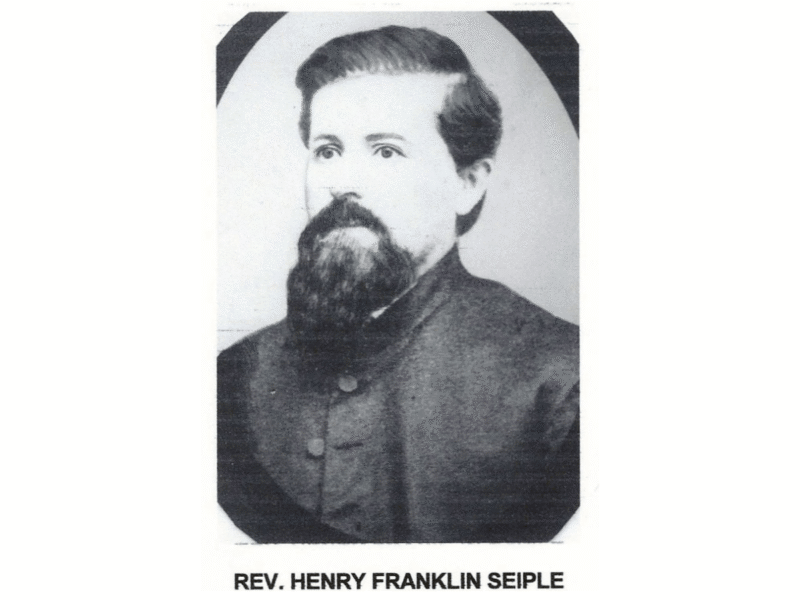
In the 150-year history of St. John’s church, the role of our first pastor, Rev. Henry Franklin Seiple, has sometimes been downplayed, as he was a shared pastor with the Hilltown and Dublin Reformed churches, and was only pastor here 5 years. But looking at his life story and his work, he was a very interesting and well-respected pastor!
Henry Seiple was born in Catasauqua, Pa. in 1843. His parents died within a year, and he was raised by an aunt and uncle. He graduated from Amherst College in 1866, then studied law (with W. H. Gibson, an attorney and judge who had just returned home to Tiffin, OH. as a colonel in the Civil War) and was admitted to the Bar in 1967. He practiced law in Bowling Green, KY. and Tiffin, OH. until 1870. In 1871 he returned to Pennsylvania and studied at the new Ursinus College of Theology under its founder, Rev. J.H.A. Bomberger, part of the Ursinus College first graduating class in 1873.
(Before we continue, let’s define a few old-church words: a ‘classis’ was similar to what we call a conference except covering a smaller area, a ‘charge’ was a pastor being assigned to several churches, usually an established church plus new ones, a ‘mission’ a new church under the leadership of a classis or an existing church.)
Rev. Seiple was ordained by the Mercersburg, PA. Classis in 1874, and installed as pastor of the Woodbury, PA. Charge, while also serving as principal of the Woodbury schools! In 1879, he became pastor of the Hilltown Charge, which also included the Reformed church in Dublin and St. John’s, previously founded and run by the Tohickon Classis but attached to Hilltown in 1878. On May 18, 1979, Rev. Seiple preached his first sermon, ‘The First Communion’, at St. John’s, and on June 30, a congregational meeting was held where Seiple was unanimously elected as St. John’s first pastor and was installed on September 23. His first salary as pastor of the Hilltown Charge (the 3 churches) was $550 a year. In 1868, Seiple had married Salome Gross of Ontario, and she joined St. John’s in July of 1879.
Rev. H. F. Seiple served as our first permanent pastor, preaching in both English and German, from 1879 (3 years after our founding in 1876) until St. John’s left the Hilltown Charge in 1884 and became an independent church of the Reformed denomination. We will continue the story of his years at St. John’s and beyond (remaining as a Lansdale resident until his passing in 1908) next month.
Jan 15, 2026
As we approach St. John’s 150th anniversary in 2026, we are digging deep into the church archives to connect with the stories that shaped us. John Hendricks, our Photographer and Archivist, has worked faithfully for 15 years to maintain and share important pieces of our history. Leaning on his extensive knowledge and storytelling ability, we are excited to share these artifacts and anecdotes as a way to honor the past and imagine what the next 150 years could bring.
by John Hendricks, St. John’s Archivist
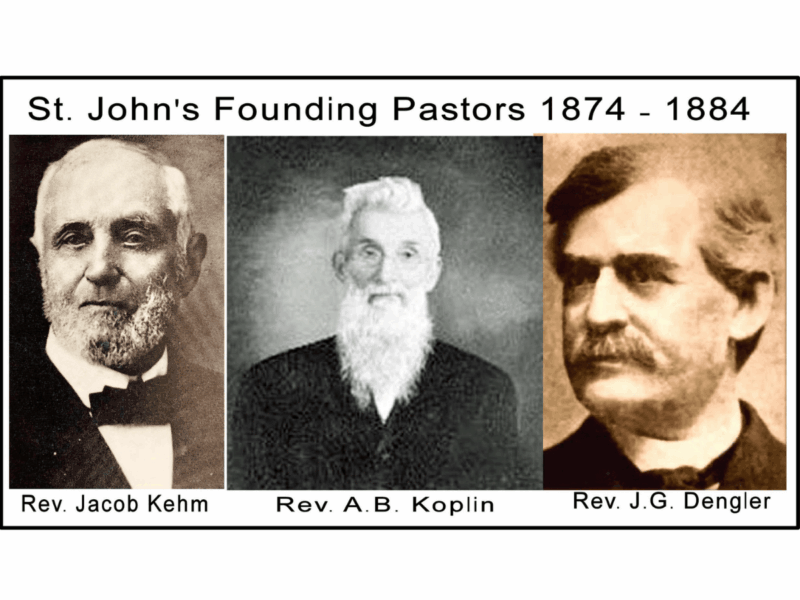
It is 2026, and you will be hearing a lot about America’s 250th birthday and its ‘founding fathers’. St. John’s is celebrating 150 years in 2026, so let’s talk about our own church founders! Two years after the incorporation of Lansdale as a town in 1872, the Reformed church Tohickon Classis (like a UCC ‘conference’ today), decided a Reformed church was needed here, so on May 15, 1874. Rev. Jacob Kehm was asked to “look after the interests of our church in Lansdale”. Rev. Keim was pastor of Indian Creek Reformed Church in Franconia and classis chair. By 1875 he was conducting services in either Althouse’s Hall or Freed’s Hall in Lansdale on Sunday evenings, alternating between English and German, also sometimes led by Rev. J.G. Dengler, the first pastor at St. Stephen’s Reformed Church in Perkasie. On January 30, 1876, 30-some members met and formed this mission of the Reformed church here, adopting a constitution and electing the first officers of the church. This is the date celebrated through history as our founding date. Soon, a lot for a building was purchased at Main & Richardson, with a cornerstone ceremony on October 15, 1876, led by both pastors.
The German Reformed Messinger in 1876 wrote “Rev. Kehm has acted with energy and skill in his work. Nearly all the labor has fallen to his share. Other neighboring brethren have aided as they could. We know of few more promising new church interests.”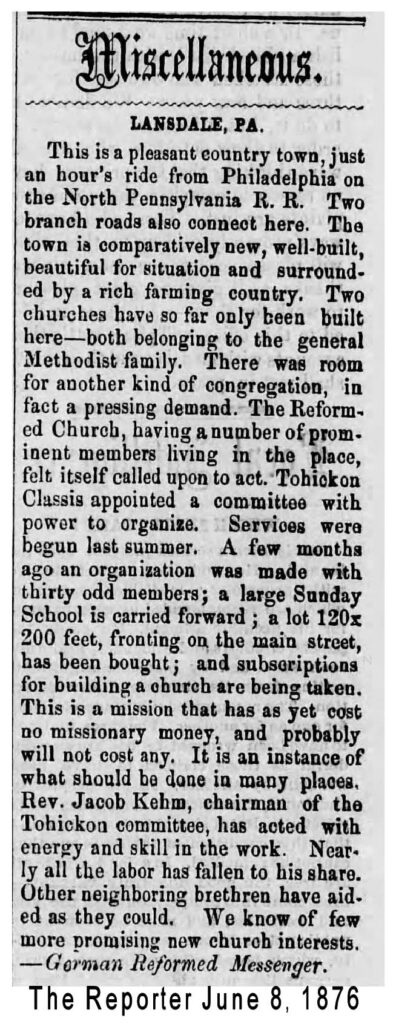
The evening services continued in the public halls until the church building was completed. Rev. Kehm resigned from these responsibilities on December 20, 1877. Rev. Dengler then shared responsibilities with Rev. A.B. Koplin, who was active in the formation of Reformed churches across Pennsylvania and served a number as pastor, and was founder and first president of the Allentown Phoebe Home. He preached the first English service in our original building on December 23, 1877, and led worship and confirmation classes here until 1884, when we became part of the Hilltown charge.
In 1898, Rev. J.J. Rothrock, our second pastor, wrote, “To Rev. Kehm belongs the honor of being founder of this congregation. To Rev. Koplin and Rev. Dengler the credit for caring for it in its infancy, and Rev. H.F. Seiple, who was its first regular pastor (from the Hilltown charge), be it said that he labored earnestly and successfully for its welfare, preparing the way for its growth and development in later years.”
Dec 10, 2025
As we approach St. John’s 150th anniversary in 2026, we are digging deep into the church archives to connect with the stories that shaped us. John Hendricks, our Photographer and Archivist, has worked faithfully for 15 years to maintain and share important pieces of our history. Leaning on his extensive knowledge and storytelling ability, we are excited to share these artifacts and anecdotes as a way to honor the past and imagine what the next 150 years could bring.
by John Hendricks, St. John’s Archivist
We are familiar with the recent traditions of the St. John’s Advent/ Christmas season. Now, thanks to the availability of The Reporter newspaper archives from 1870 to 1970 on the internet, we have insight into Christmas celebrations here in the 1880’s.
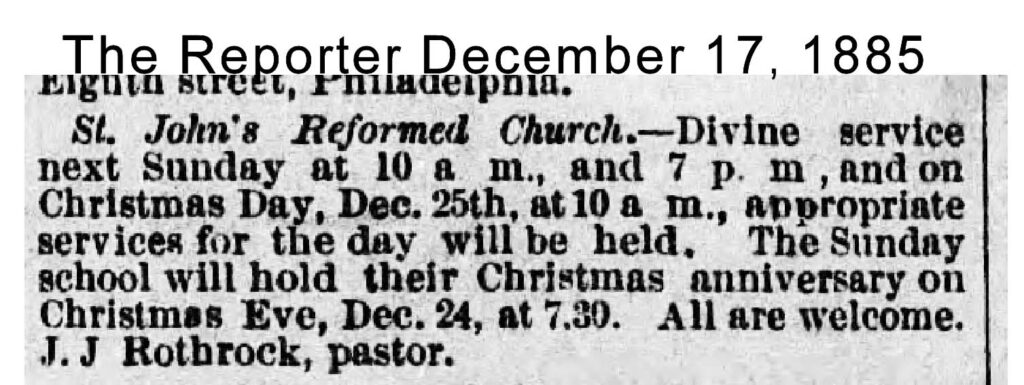
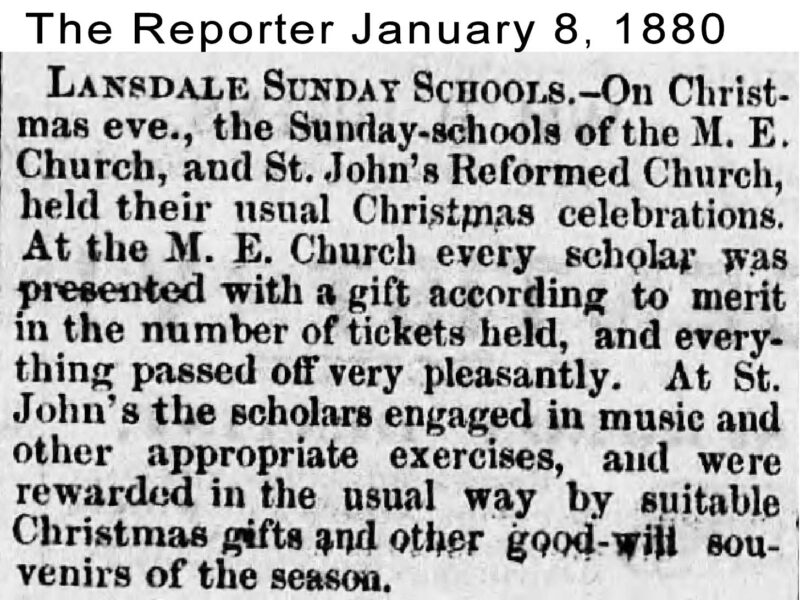
The first listing for a Christmas Day 10 am service at St. John’s was in 1885, simply stating “appropriate services for the day will be held”. However, we find that the biggest event was the Christmas Eve service, run by the Sunday School, much like our early Christmas Eve service in recent times has been a ‘family’ service. The Reporter of January 8, 1880, wrote the Sunday School held their “usual Christmas celebration”, implying this had been held for several years before 1879. The article continued, “the scholars engaged in music and other appropriate exercises and were rewarded in the usual way by suitable Christmas gifts and other good-will souvenirs of the season.”
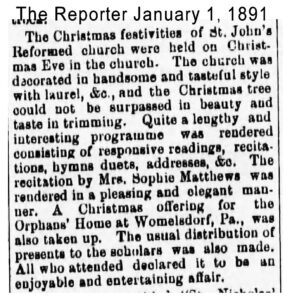
The Reporter of January 1, 1891, described the 1890 service. “Quite a lengthy and interesting program was rendered consisting of responsive readings, hymn duets and recitations…An offering for the Orphan’s Home at Womelsdorf was taken up (note: we continue to this day giving support to what is now called Bethany Home). The usual distribution of presents to the scholars was also made. All who attended declared it to be an enjoyable and entertaining affair.” Articles from future years describe the children’s Christmas Eve gifts as a box of candy and an orange, piled under the tree.
It is interesting to note none of the articles about St. John’s, or any other local churches in that time, mention the season of Advent, so much a part of our worship celebration today. The church was decorated for the Christmas Eve service, noting that real trees and greens would have been a possible fire hazard if put up earlier. From the 1891 article, “the church was decorated in handsome and tasteful style with laurel, etc., and the Christmas tree could not be surpassed in beauty and taste in trimming”. (Much like our “hanging of the greens” today, it is always inspiring to enter our decorated sanctuary the first Sunday in Advent.) The celebration of Christmas has changed somewhat in 150 years, but the message is unchanged. “For unto you is born this day in the city of David a Savior, which is Christ the Lord.” (Luke 2:11 KJV) Merry Christmas to the St. John’s family! Be with us for our 150th anniversary in 2026!
Nov 11, 2025
As we approach St. John’s 150th anniversary in 2026, we are digging deep into the church archives to connect with the stories that shaped us. John Hendricks, our Photographer and Archivist, has worked faithfully for 15 years to maintain and share important pieces of our history. Leaning on his extensive knowledge and storytelling ability, we are excited to share these artifacts and anecdotes as a way to honor the past and imagine what the next 150 years could bring.
by John Hendricks, St. John’s Archivist
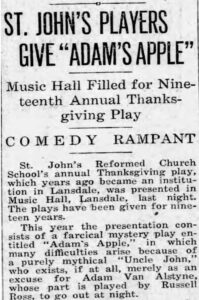
13 years before St. John’s founding, in 1963, President Lincoln declared Thanksgiving a national holiday, although an autumn day set aside for thanksgiving was observed since the 17th century in many places to celebrate a bountiful harvest. Holding a big family feast serving turkey on that day was also a tradition. ‘The Reporter’ of Nov. 14, 1872, said, “Thanksgiving Day is coming around again with its family gatherings, roast turkey and general hymns of praise to our bountiful Creator, who has blessed our land with fruitfulness and peace.” The first known Thanksgiving worship service at St. John’s was in 1882. And soon, the hottest ticket in Lansdale on Thanksgiving evening for 22 years would be from productions by the St. John’s Sunday School!
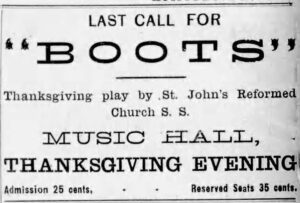
On Nov. 11, 1909, ‘The Reporter’ announced, “On Thanksgiving night, a musical extravaganza entitled ‘The Life of a Leaf’, followed by a spicy comedy, will be given in Music Hall by St. John’s Reformed Sunday School”. Music Hall was an auditorium built in 1888 at N. Broad & 2nd Streets, seating an audience of 600! The St. John’s Sunday School Thanksgiving night play soon became an annual Lansdale tradition. ‘The Reporter’ in 1914 noted the play would be “’Esleralda’, a comedy-drama of unusual merit and a cast of Lansdale’s talented amateurs should ensure enjoyable evenings” (now Thursday and Friday evenings to accommodate the large crowds). Admission was 25 cents, reserved seats 35 cents, limit 8 tickets per sale.
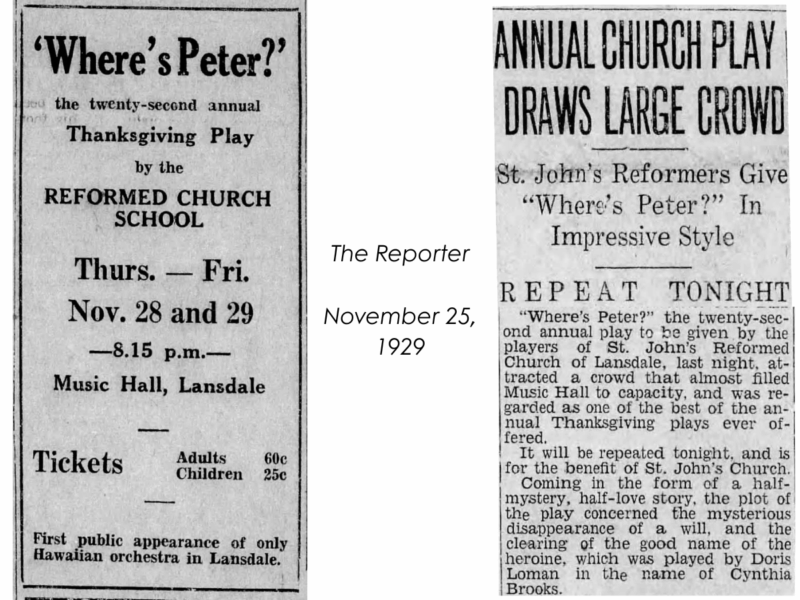
Changes took place over the years. In 1917, the play took the form of “a ten-reel moving feature entitled ‘Jack and the Beanstalk’”. There was no play in 1919. In 1920, “an old-fashioned talent play” was put on by the St. John’s Ushers Association, but the Sunday School plays returned in 1921. The 1923 farcical comedy ‘Sick-A-Bed’ was sold out. ‘The Reporter’ in 1926 noted the plays “years ago became an institution in Lansdale”. The final play at the Music Hall, 1929’s “Where’s Peter?”, was reviewed as one of the best. After having no play in 1930, one last play, ‘The Little Clodhopper’, was held in 1931, but this time in the York Avenue School.
What caused the end of the plays? Changing times? The impact of the Depression of 1929? The opulent Lansdale Theatre opened to compete with the Music Hall? We don’t know, but for a time a century ago, St. John’s offered the hottest ticket in town!
Oct 27, 2025
Written by Rev. Tom Adil
This holiday is a yearly reminder (November 1 and in church, the 1st Sunday in November) of our connectedness as Christians to the church. Perhaps you were taught to think of saints as figures in the church’s stained-glass windows. But the Bible teaches something beyond this. Who is a saint? You are. That is if you’re a follower of Jesus. The Church calls a “saint” those who trust God-in-Christ for salvation.
The origin of All Saints’ Day can be traced back to the early Christian Church when it was established as a day to remember and celebrate the martyrs and other saints who had died for their faith. Over time, the scope of the holiday expanded to include martyrs and all faithful Christians who had lived pious and virtuous lives. It is a day to recognize the saints’ collective witness and express gratitude for their example.
Over time, the holiday’s focus expanded beyond just martyrs to include all Christian saints—those who were recognized for their exceptional holiness and devotion to God. This shift recognized that not all saints were martyrs, so a broader commemoration was needed.
The Christian festival of All Saints Day comes from a conviction that there is a spiritual connection between those in Heaven and on Earth. While traditions across the globe vary for All Saints Day, the common theme is a celebration with family and remembrance of those who have passed.
If you have a loved one who passed beween October 2024 and October 2025, and you would like them included in our All Saints List, please contact the office by Wednesday, October 29, 2025 with their name and relation to you.
The All Saints List is read during All Saints Sunday morning service, and featured in the bulletin. The full list will be available in next month’s Enlightener.
Oct 08, 2025
As we approach St. John’s 150th anniversary in 2026, we are digging deep into the church archives to connect with the stories that shaped us. John Hendricks, our Photographer and Archivist, has worked faithfully for 15 years to maintain and share important pieces of our history. Leaning on his extensive knowledge and storytelling ability, we are excited to share these artifacts and anecdotes as a way to honor the past and imagine what the next 150 years could bring.
by John Hendricks, St. John’s Archivist
If someone asked what ‘harvest home’ means, you’d probably think of the familiar Thanksgiving hymn (NCH #422) with the opening lines, “Come, O thankful people, come, raise the song of harvest home”. Some of our long-time members will remember that ‘harvest home’ was once a special day in the church year!
The Reporter newspaper of December 23, 1897, wrote “Wherever throughout the earth there is such a thing as a formal harvest there appears to be an inclination to mark it with a festive celebration. In England this festival passes generally under the endeared name of harvest home.” In our area, going back to the late 1800’s, Harvest Home was not only observed in all the local churches with special services, but also in special outdoor ‘fun’ festivals held by lodges and civic groups, with picnics, games, and speeches. These were held in late summer on various dates. There is not much information on these early services at St. John’s, but The Reporter noted a Wednesday night Harvest home service here in 1887 and by 1905 said it was an “annual service”.
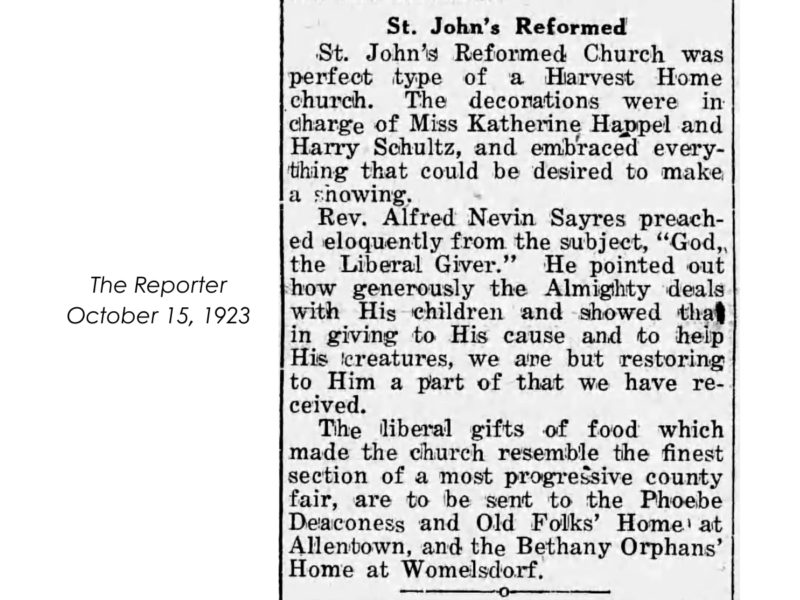
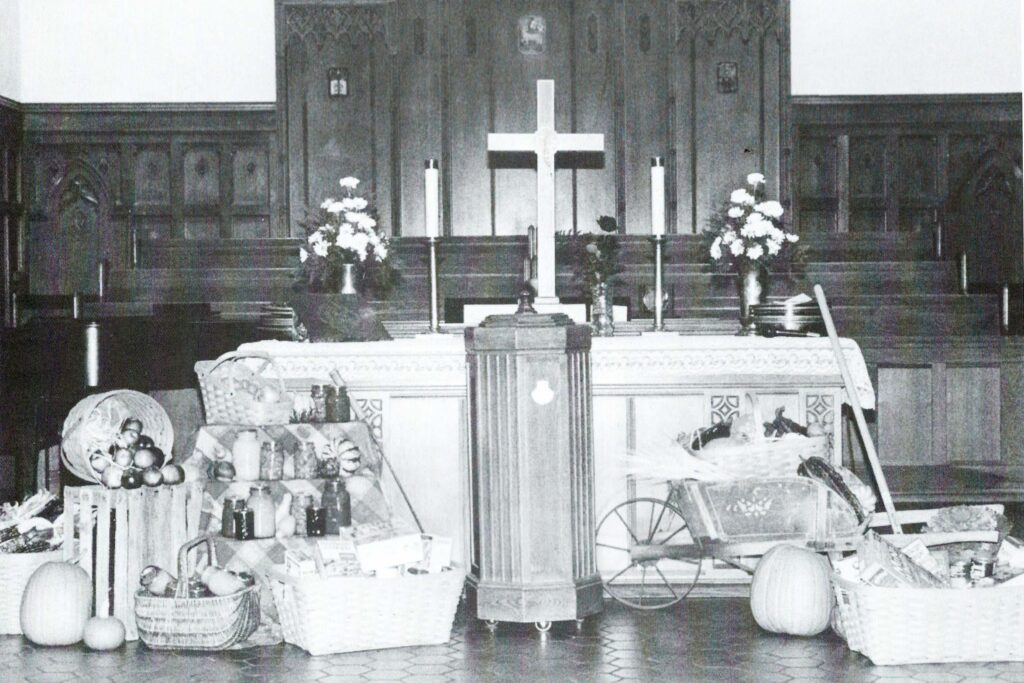
By the 1900’s the secular observations had ended but Harvest Home services continued in area churches. At St. John’s, the ‘golden era’ of the Harvest Home services began with the arrival in 1923 of Rev. Sayres, our third pastor. A tradition started that the church was colorfully decorated for autumn, and the congregation brought home-preserved food for charity. The Reporter of October 15, 1923 noted “St. John’s Reformed Church was (the) perfect type of a Harvest Home church…and embraced everything that could be desired to make a showing…Rev. Alfred Sayres preached eloquently from the subject, “God, the Liberal Giver”…the liberal gifts of food which made the church resemble the finest section of a most progressive county fair, are to be sent to the Phoebe Deaconess and Old Folks Home in Allentown and Bethany Orphans Home in Womelsdorf.” (Note: we still support Phoebe Allentown and Bethany Children’s Home.)
Harvest Home continued as an annual service through the 1940’s. There were a few revivals after that, but fewer members grew and preserved foods now, and the ways of collecting and donating food changed, culminating with our founding Manna on Main Street in 1980 as a year-round food bank. But for many years, especially during the Depression, Harvest Home was an important part of our St. John’s outreach, sharing God’s bounty!
Sep 01, 2025
As we approach St. John’s 150th anniversary in 2026, we are digging deep into the church archives to connect with the stories that shaped us. John Hendricks, our Photographer and Archivist, has worked faithfully for 15 years to maintain and share important pieces of our history. Leaning on his extensive knowledge and storytelling ability, we are excited to share these artifacts and anecdotes as a way to honor the past and imagine what the next 150 years could bring.
by John Hendricks, St. John’s Archivist
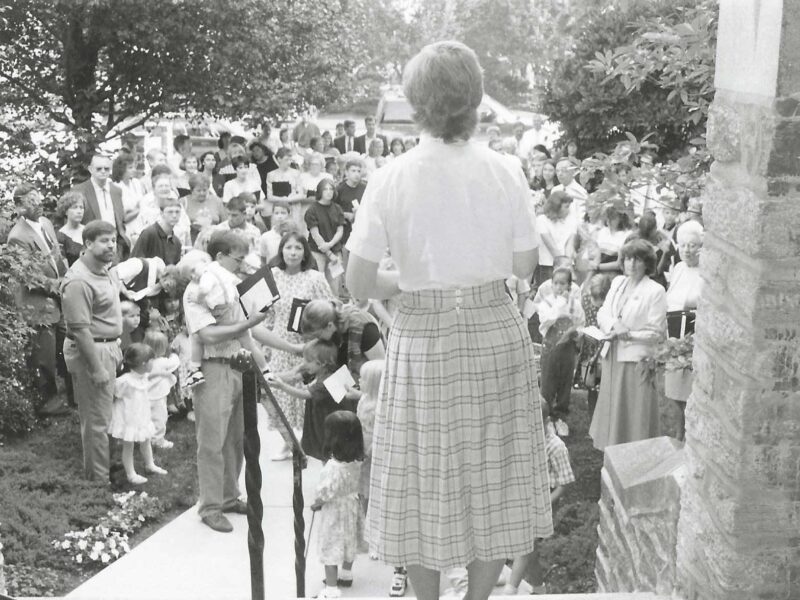
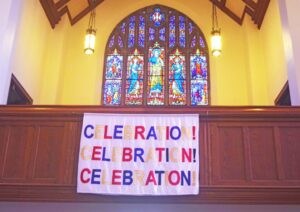
photo: Rev. Sue Bertolette on the steps, Celebration Sunday 1998.
On September 7th we will observe ‘Celebration Sunday’. This is traditionally the day we return to our full calendar of activities after summer break and vacations. Did you know this tradition goes back over 100 years at St. John’s?
At St. John’s and most churches, starting in the 1920’s, this was known as ‘Rally Day’, a Sunday to come together after summer and build excitement for the Sunday School’s upcoming year. A standout Rally Day was in September 1923, when 2,110 people from every church Sunday School in the borough marched together in a Rally Day parade in downtown Lansdale on a Saturday afternoon, described by The Reporter as Lansdale’s “Greatest Religious Event”. The parade marched to Memorial Park where there was singing (led by St. John’s choir leader, M. Ellen Geller) and speeches. The next day each church held its own Rally Day, and The Reporter headline read “Reformed Show Largest Attendance”, with 470 persons attending at St. John’s!
Rally Day continued at St. John’s for another 60+ years. One of the long-held traditions, before we became aware as ‘creation stewards’, was a colorful ‘balloon release’ on the front lawn following worship. The balloons had tags attached and many were returned from all over the area. When we became aware of the environmental consequences to animals and waterways after the balloons landed, this tradition purposely ended.
Looking for a new identification, in 1987 the name of the event was changed to “Celebration Sunday”. The Sunday School students were joined by congregants arriving for worship in the front courtyard. The Associate Pastor led the ceremony and the Children’s Choir director would lead the crowd in singing. In 2013, the gathering moved to the new back courtyard, with crowds filling the courtyard, the ramp and into the parking lot! Each person received a token gift reminding us of our new theme for the year.
As with many traditions, the pandemic brought changes to Celebration Sunday. In 2020, a ‘spread-out’ event took place in our various parking lots. Since there was no return to classes or activities, Celebration Sunday was not ‘celebrated’ for a few years. Now we are rebuilding a full schedule of worship and activities for 2025 and beyond, with new hopes and new leadership. Come and be part of St. John’s history on September 7th at 10:15 am!
Aug 21, 2025
As we approach St. John’s 150th anniversary in 2026, we are digging deep into the church archives to connect with the stories that shaped us. John Hendricks, our Photographer and Archivist, has worked faithfully for 15 years to maintain and share important pieces of our history. Leaning on his extensive knowledge and storytelling ability, we are excited to share these artifacts and anecdotes as a way to honor the past and imagine what the next 150 years could bring.
by John Hendricks, St. John’s Archivist
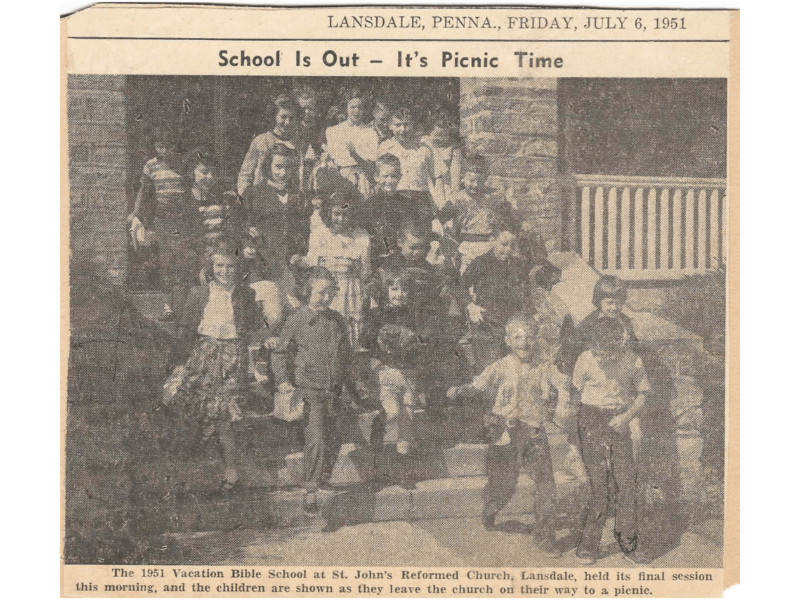
image: photocopy of a July 6, 1951 newspaper photograph captioned “The 1951 Vacation bible School at St. John’s Reformed Church, Lansdale, held its final session this morning, and the children are shown as they leave the church on their way to a picnic.”
Vacation Bible School (VBS) has a long history at St. John’s. In fact, we celebrated our 100th VBS during Fellowship on August 6, 2023! In looking through the St. John’s archives, we learned some interesting facts about St. John’s VBS history.
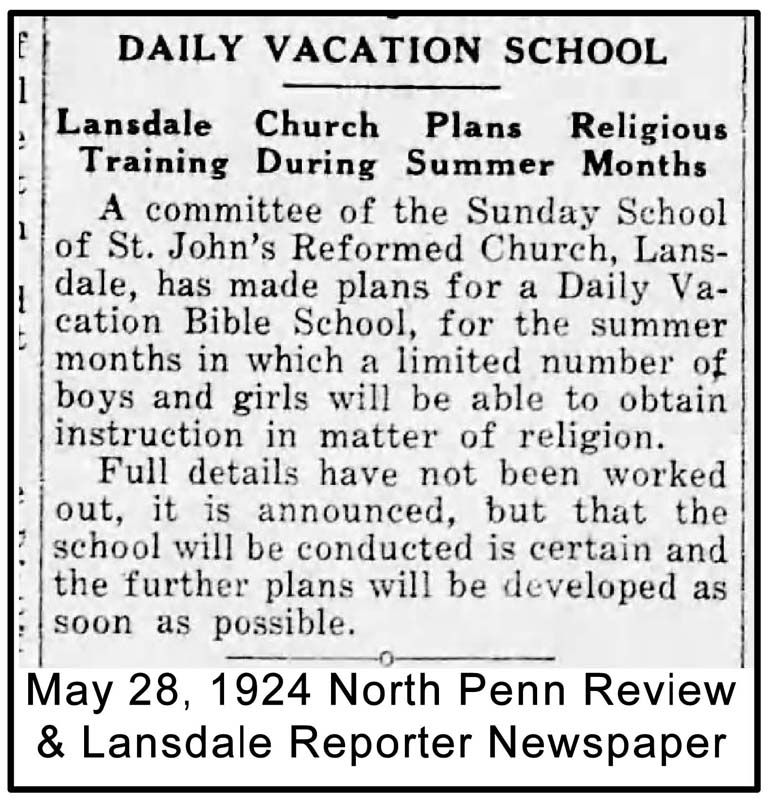
On May 28, 1924, it was announced in The Reporter newspaper that at St. John’s “in the summer months… a limited number of boys and girls will be able to obtain instruction in matter of religion”. VBS began on June 30 with 70 students attending, and ended August 1 after five weeks of sessions, closing with a Friday evening commencement ceremony and exhibit of what was learned! The cost to run the VBS was $155.00 for the five weeks.
VBS continued to grow in the next decade, with expanded classes and activities including class picnics over the five weeks and an ice cream treat the last week. The closing evening event displaying handiwork also continued. Initially a $1.00 registration fee was collected from each student, but this was dropped during the depression so no child would be left out who couldn’t afford that fee. In 1929 another tradition began, collecting items for youth organizations in need. The first few years was for an African American school supported by the Reformed and Presbyterian denominations. In the past few years we collected for Urban Promise in Camden, with many other organizations helped in-between.
Over the years the sessions shortened, 1935 to four weeks, 1950 to three weeks, 1953 to two weeks, and 1975 to one week. The sessions included Bible study, Bible quiz, worship, handiwork and recreation. St. John’s members who grew up here fondly remember the daily Kool-Aid and pretzel rod snacks, too!
In 1999 VBS moved from mornings to evenings and added a class for adults. This continued until the 2020 pandemic, when VBS “Take-Out” boxes were made available to the children. In 2021 we combined take-out with 3 in person gatherings. In 2023 and 2024 VBS was “reimagined” as “Volunteer. Believe. Serve.”, with hands-on service projects for all ages.
On Saturday morning, August 23, we will gather for the 102nd year for a 3-hour session for all ages. The theme is “Building on the Rock”, and we are certainly building on the foundation that our St. John’s VBS teachers, administrators and students laid out for us over a century ago!
Sign up to receive emails from St. John's.